
Aesthetic Medicine & 3D Imaging Blog
Latest clinical research, technical advances, and practice growth insights from LifeViz®.
Flagship AI Skin Diagnostic Hardware Portfolio
Engineered for aesthetic hospitals, dermatological research institutes, and high-end medspas requiring clinical precision and reproducible volumetric evaluation.

3D AI Smart Full Face Skin Analyzer HD Imaging Touch Screen Facial Scanner Detect Acne Pigmentation Wrinkles Pores Moisture
- 3D Volumetric Mesh Surface Analysis
- Integrated HD Capacitive Touch Display
- Multi-Spectral Deep Subdermal Mapping

Skin Analysis Device Facial Scanner Diagnosis 3D System Testing Moisture Evaluation Digital Inspection Pigmentation Aging Pore
- Quantitative Age-Index Algorithm
- Deep UV & Porphyrin Fluorescence
- High-Resolution Optical Sensor Matrix

Medical-Grade AI Skin Diagnostic Device Puremi Fourth Gen 6 Spectrums 19 Reports Dual Shooting Modes Front/Side Face Analysis
- 6 Precision Light Spectrums
- 19 Automated Clinical Reports
- Dual Angle Shooting Positioning

High Quality Portable Facial Analysis Skin Monitor Analyzer 3D Digital Skin Analyzer Machine For Salon
- Lightweight Compact Ergonomics
- Fast 15-Second Optical Scan
- Tablet & PC Wireless Interface

NEW Portable Woods Lamp Medical Grade Microscope Dermatoscope Rechargeable Skin Hair Analyzer
- Medical Wood's Light Illumination
- High Magnification Micro Lens
- Rechargeable Lithium Battery

New Arrival 3D Skin Analyzer Facial Machine Skin Analysis Scanner Facial Skin Analyzer Machine
- Auto-Focus Optical Module
- Pore & Sebum Micro-Detection
- Real-Time Comparative Overlay

Medical Grade Skin Analyzer Device With Imaging for Skin Condition Diagnosis
- Dermatological Pathology Focus
- Cross-Polarized Vascular Analysis
- DICOM Compatible Cloud Output
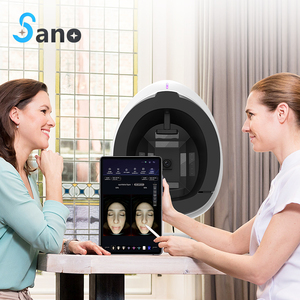
2026 Skin Analysis Machine UV Pore Detector Skin Scanner Analysis Ai Skin Analyzer Beauty Machine For Salon
- Enhanced UV Pore Fluorescence
- AI Deep Learning Recommendation
- Ultra-Fast Dual Spectrum Flash
Factory Authority & Manufacturing Capability
Backed by 25+ years of continuous optical innovation, 14 global patents, and deployment in over 50 countries worldwide.
ISO13485 Cleanroom Manufacturing
Our state-of-the-art optical assembly facilities adhere strictly to ISO13485 standards. Every sensor, lens group, and LED spectral emitter undergoes 72-hour thermal stress testing and micro-calibration prior to shipment.
Proprietary Multi-Spectral Optics
Unlike standard RGB cameras, our hardware integrates custom cross-polarized filters, parallel polarization matrices, UV 365nm LEDs, and Wood's light sources to capture epidermis and dermis structural integrity without image noise.
Turnkey OEM/ODM White-Label Solutions
We provide full-stack OEM customization ranging from industrial exterior design, customized optical spectrum selection, customized GUI software branding, and cloud API SDK integrations for global skincare brands and distributor networks.
Industrial Whitepaper: The Optical & Algorithmic Architecture of Modern Skin Diagnostics
An authoritative analysis of multi-spectral light interaction, 3D volumetric displacement mapping, and clinical validation protocols.
1. The Evolution of Quantitative Skin Diagnostics: From 2D RGB to 3D Multi-Spectral Scanning
Over the past decade, dermatological diagnostic hardware has evolved from basic 2D color photography to sophisticated multi-spectral, volumetric 3D reconstruction systems. Early generation devices relied exclusively on standard RGB (Red-Green-Blue) white light illumination, which captured surface-level epidermal features such as macro-wrinkles and visible hyperpigmentation. However, standard diffuse lighting fails to penetrate the stratum corneum or differentiate between superficial melanin and deep dermal vascular structures.
Modern medical-grade diagnostic hardware developed by our R&D laboratories utilizes Narrowband Cross-Polarized and Parallel-Polarized Light Filtering. Cross-polarization effectively cancels out specularity (surface shine), allowing optical sensors to record sub-surface chromophore distribution—specifically hemoglobin concentration and deep-seated melanin deposits. Conversely, parallel polarization amplifies specular reflection, facilitating ultra-high-resolution mapping of micro-relief textures, stratum corneum desquamation, and pore structural elasticity.
2. Multi-Spectral Breakdown & Subdermal Diagnostic Physics
To achieve reproducible diagnostic accuracy across diverse Fitzpatrick skin types, our 4th-generation hardware implements a synchronized six-spectrum optical array:
| Illumination Spectrum | Optical Wavelength | Target Tissue Layer | Clinical Diagnostic Application |
|---|---|---|---|
| Standard RGB Light | 400 nm – 700 nm | Epidermal Surface | Macro wrinkles, visible acne lesions, overall skin tone uniformity. |
| Cross-Polarized Light | 450 nm – 680 nm (Filtered) | Basal Layer & Upper Dermis | Deep pigmentation, melasma, subsurface sun damage, spot boundary definition. |
| Parallel-Polarized Light | 450 nm – 680 nm (Aligned) | Stratum Corneum | Fine lines, pore volume, skin texture roughness, surface lipid film. |
| UVA Black Light | 365 nm Peak | Follicular Infundibulum | Porphyrin detection (Propionibacterium acnes activity), clogged pores, sebum output. |
| Medical Wood's Light | 320 nm – 400 nm | Epidermal-Dermal Junction | Differential diagnosis of fungal infections, vitiligo, and epidermal vs. dermal melasma. |
| Brown / Red Tone Separation | Algorithmic Optical Splitting | Dermal Micro-Vascular Net | Telangiectasia, erythema, rosacea, post-inflammatory hyperpigmentation (PIH). |
3. 3D Stereophotogrammetry & Volumetric Displacement Analysis
A critical limitation of conventional facial scanners is the inability to quantify facial volume loss, tissue sagging, or injectable filler distribution. Our CE-certified 3D diagnostic scanners utilize dual-camera or structured-light stereophotogrammetry to construct a digital twin of the patient's facial contour with sub-millimeter geometric accuracy.
By capturing synchronous multi-angle stereo images, the onboard FPGA processor computes a high-density 3D point cloud mesh. Specialized algorithms perform Volumetric Difference Mapping before and after clinical procedures (such as hyaluronic acid dermal filler injections, autologous fat transfer, or thread lifting). Clinicians can demonstrate precise volume augmentation in cubic centimeters ($cm^3$) or measure vector skin lifting in millimeters, establishing an unprecedented benchmark for patient transparency and clinical validation.
Global Procurement Trends (2026–2030)
Strategic foresight for device distributors, medical equipment buyers, and aesthetic franchise chains.
1. Migration to Cloud Ecosystems & Multi-Site Sync
Global clinic chains are rapidly phasing out isolated, desktop-locked diagnostic software. Procurement strategies now prioritize hardware with built-in Cloud API architecture (such as HIPAA/GDPR-compliant cloud synchronization). Centralized cloud storage enables multi-location patient profile access, remote dermatological consultations, and unified enterprise analytics across international clinic networks.
2. AI-Driven Quantitative Outcome Validation
Consumers are demanding objective, empirical proof of cosmetic treatment efficacy. Procurement trends indicate a massive shift toward diagnostic machines equipped with automated AI Before/After Comparison Engines. Devices capable of generating quantitative delta reports—showing percentage reductions in pore area, vascular redness, or melanin index—achieve 40% higher consultation conversion rates in medspas.
3. Hardware Modularization & Hybrid Form Factors
Modern clinics require versatile hardware capable of switching between full-face 3D scanning booths and ultra-close-up handheld microscopic analysis. Future procurement contracts overwhelmingly favor modular platforms where high-resolution handheld Wood's lamps or dermastopes communicate seamlessly with the master 3D facial analyzer central console.
Technological Development Trends in AI Skin Diagnostics
Key innovations driving the next technological leap in non-invasive skin assessments.
Edge AI Accelerators & Zero-Latency Neural Processing
Traditional skin analyzers rely on sending raw high-resolution images to remote cloud servers for AI diagnostic processing, leading to latency and workflow bottlenecks during patient consultations. The integration of high-performance Edge Neural Processing Units (NPUs) directly onto the scanner's main control motherboard allows real-time segmentation and pattern recognition. Deep learning models run locally within seconds, instantly categorizing complex dermatological conditions including inflammatory acne, comedones, dyschromia, and vascular hyper-reactivity.
Hyperspectral Imaging (HSI) & Subsurface Micro-Vascular Mapping
Emerging research in medical optics is pushing beyond standard RGB and polarized light toward Hyperspectral Imaging (HSI). By capturing hundreds of narrow spectral bands across the visible and near-infrared (NIR) spectrum, future diagnostic devices will non-invasively measure subcutaneous oxygen saturation ($StO_2$), tissue water content, and collagen density maps without biopsies or invasive procedures.
Generative Predictive Aging & Treatment Simulation Engines
Leveraging generative AI trained on millions of clinically validated dermatological datasets, next-generation diagnostic hardware offers predictive simulation tools. Clinicians can present 5-year skin trajectory forecasts under various conditions: untreated UV exposure versus adhering to prescribed medical skincare regimens, laser resurfacing, or biostimulatory injectable treatments.
B2B Buyer & Procurement FAQ
Essential insights for international distributors, medical device importers, and enterprise purchasing managers.
Our complete range of AI skin diagnostic hardware is fully CE certified under European Safety and Electromagnetic Compatibility regulations. Manufacturing processes follow strict ISO13485 quality management systems for medical devices. We provide CE certificates, RoHS compliance documentation, and test reports required for customs clearance in Europe, North America, Southeast Asia, and the Middle East.
Standard 2D skin analyzers only evaluate surface flat images, making them susceptible to lighting inconsistencies, facial angle distortions, and zero volumetric tracking. Our 3D multi-spectral devices combine precise stereophotogrammetry mesh modeling with 6 spectral light channels (RGB, Cross-Polarized, Parallel-Polarized, UV 365nm, Wood's Light, and Vascular Separation). This enables quantitative sub-surface tissue analysis, volumetric displacement calculation for dermal fillers, and repeatable 3D image registration.
As an original hardware manufacturer, we offer end-to-end OEM/ODM customization. This includes custom casing silk-screen branding, hardware color schemes, customized GUI software interfaces with your company logo, customized patient report header templates, multi-language software localization (English, Spanish, French, German, Arabic, Japanese, etc.), and custom SDK/API integration into your existing clinic management database.
Security is embedded at the hardware and software layer. All patient data, high-resolution scans, and diagnostic reports stored locally or transmitted to cloud platforms are encrypted using AES-256 bit enterprise encryption standards. Systems compliant with GDPR and HIPAA include role-based user authentication, automated cloud backup protocols, and strict patient consent logging features.
Our optical diagnostic systems are engineered for industrial longevity with an operational lifespan exceeding 50,000 illumination hours for our solid-state medical LED modules. Devices feature automated internal self-calibration upon boot-up to ensure color temperature and polarization consistency over time. All hardware includes a standard 2-year factory warranty, complete spare parts availability, and 24/7 online technical support for global partners.
For standard branded inventory, the sample MOQ is 1 unit, with dispatch within 3 to 5 business days. For OEM/ODM custom orders (custom branding, packaging, software localization), the typical initial order MOQ is 10 to 50 units depending on the depth of hardware modifications, with a production lead time of 14 to 21 business days.
Partner with a World-Class Optical Diagnostic Manufacturer
Expand your product portfolio or elevate your clinic chain's diagnostic accuracy with certified 3D AI skin analyzers. Contact our engineering team today to request complete product catalogs, factory direct pricing, and OEM customization packages.
Get Catalog