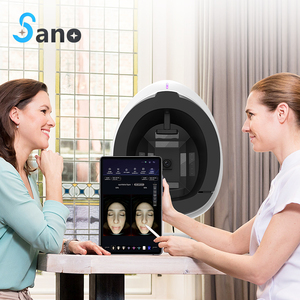
CE Medical Grade Certified Manufacturer

CE Certified Wireless Clinical Skin Diagnostic Scanner Manufacturer & Factories

Next-Generation 3D AI Multi-Spectral Dermatological Diagnostic Systems, Volumetric Surface Reconstruction & Cloud-Connected Clinical Workflows

Clinical Product Portfolio

CE Certified Skin Diagnostic Scanners

Engineered for dermatologists, plastic surgeons, and high-end medical aesthetic clinics worldwide. Explore our CE certified 3D multi-spectral diagnostic scanner series.

3D AI Flagship 3D AI Smart Full Face Skin Analyzer HD Imaging Touch Screen Facial Scanner

3D AI Smart Full Face Skin Analyzer HD Imaging Touch Screen Facial Scanner Detect Acne Pigmentation Wrinkles Pores Moisture

Get a Quote
Multi-Spectral Skin Analysis Device Facial Scanner Diagnosis 3D System Testing Moisture Evaluation

Skin Analysis Device Facial Scanner Diagnosis 3D System Testing Moisture Evaluation Digital Inspection Pigmentation Aging Pore

Get a Quote
Medical Grade Medical-Grade AI Skin Diagnostic Device Puremi Fourth Gen 6 Spectrums

Medical-Grade AI Skin Diagnostic Device Puremi Fourth Gen 6 Spectrums 19 Reports Dual Shooting Modes Front/Side Face Analysis

Get a Quote
Portable 3D High Quality Portable Facial Analysis Skin Monitor Analyzer 3D Digital Machine

High Quality Portable Facial Analysis Skin Monitor Analyzer 3D Digital Skin Analyzer Machine For Salon & Clinical Clinics

Get a Quote
Wood's Lamp Micro Portable Woods Lamp Medical Grade Microscope Dermatoscope

NEW Portable Woods Lamp Medical Grade Microscope Dermatoscope Rechargeable Wireless Skin & Hair Follicle Analyzer

Get a Quote
Clinical Scanner New Arrival 3D Skin Analyzer Facial Machine Skin Analysis Scanner

New Arrival 3D Skin Analyzer Facial Machine Skin Analysis Scanner High Precision Facial Skin Analyzer Machine

Get a Quote
Diagnostic Imaging Medical Grade Skin Analyzer Device With Imaging for Skin Condition Diagnosis

Medical Grade Skin Analyzer Device With Precision Imaging for Sub-Dermal Skin Condition Diagnosis & Consultation

Get a Quote
2026 Next-Gen 2026 Skin Analysis Machine UV Pore Detector Skin Scanner

2026 Skin Analysis Machine UV Pore Detector Skin Scanner Analysis AI Skin Analyzer Medical Beauty Machine For Salon & Hospital

Get a Quote
25+
Years R&D Excellence
14
International Patents
50+
Countries Deployed
7
Global Design Awards
OEM & ODM Manufacturing Superiority

Why Global Medical Brands Partner With Our Factory

Combining CE MDR compliance, medical-grade optical engineering, wireless ultra-low latency data streaming, and cloud AI architecture.

CE MDR Medical Compliance

Our OEM/ODM manufacturing facilities adhere to strict ISO 13485 quality systems. Every wireless diagnostic scanner undergoes rigorous optical calibration, electrical safety testing (IEC 60601-1), and electromagnetic compatibility verification for seamless regulatory clearance across the EU, UK, and Americas.

6-Spectrum Optical Matrix

Utilizing high-definition CMOS sensors coupled with 6 distinct light spectrums—including Standard RGB, Parallel Polarized, Cross-Polarized, UV (365nm Wood's Light), Red Spectrum, and Brown Spectrum—revealing epidermal and deep dermal structures in sub-millimeter detail.

Neo Cloud™ Software Ecosystem

Fully integrable with central cloud repositories. Allows multi-site clinic networks to automatically synchronize 3D patient records, perform automated AI facial matching, generate standardized before/after volume differential maps, and streamline patient consultation workflows.

Factory Benchmark Specifications

Clinical Scanner Hardware & Spectrum Specifications

Feature Parameter Clinical Standard (Gen-4 Puremi & 3D AI Systems) Clinical & Commercial Advantage
Optical Spectrum Array 6 Spectrums (RGB, Cross-Polarized, Parallel-Polarized, UV 365nm, Red Light, Wood's UV) Isolates epidermal texture, deep vascular erythema, porphyrins, and sub-dermal melanin density.
3D Surface Mesh Precision Sub-millimeter volumetric mapping (< 0.1mm depth accuracy) Accurately quantifies facial volume displacement (fillers, fat grafting, threads) and skin lifting.
Wireless Protocol Dual-Band Wi-Fi 6E (5.8 GHz) + Bluetooth 5.3 Low Energy Instant HD image transmission without tethering cables, enabling total hand-held flexibility in clinic rooms.
AI Diagnostic Matrix 19 Detailed Quantitative Diagnostic Reports Automated scoring for pore size, sebum balance, wrinkle depth, moisture index, hyperpigmentation, and vascularity.
Certification & Compliance CE MDR (EU 2017/745), ISO 13485:2016 Factory Quality Standard Ensures full legal eligibility for sales into hospitals, dermatology practices, and cosmetic surgery chains globally.
Software Integration Neo Cloud SaaS, API/SDK available for EHR integration Centralized multi-location data management with HIPAA & GDPR compliant end-to-end encryption.

Industry Whitepaper: The Evolution of CE Certified Wireless Clinical Skin Diagnostic Scanners

In modern aesthetic medicine, plastic surgery, and clinical dermatology, objective assessment has superseded subjective visual inspection. The rapid transformation toward non-invasive cosmetic procedures, bio-remodeling injectables, and energy-based device (EBD) therapies requires diagnostic tools capable of measuring microscopic dermal changes with repeatable precision. As a premier CE certified wireless clinical skin diagnostic scanner manufacturer and global OEM factory, we engineer state-of-the-art diagnostic instruments designed to elevate patient trust, optimize treatment planning, and provide incontrovertible visual evidence of clinical efficacy.

1. The Paradigm Shift: Why Wireless 3D Multi-Spectral Scanning Is Essential

Traditional 2D photography suffers from inherent limitations: inconsistent lighting angles, fluctuating focal distances, surface glare, and an inability to track volumetric alterations. In contrast, medical-grade 3D skin scanners combine advanced optical stereophotogrammetry with multi-spectral illumination matrixes to reconstruct a true 360-degree digital twin of the patient's face or anatomical body site.

By capturing the skin under specific narrow-band light wavelengths, clinicians can peer beneath the stratum corneum without invasive procedures:

  • Standard RGB Light: Captures surface skin tone, visible blemishes, superficial texture, and macro-pores under daylight-balanced color temperature.
  • Cross-Polarized Light: Eliminates specular reflection from the skin surface, exposing sub-surface hemoglobin concentrations, telangiectasia, rosacea, and inflammatory acne.
  • Parallel-Polarized Light: Enhances surface fine lines, micro-wrinkles, pore structural collapse, and epidermal smoothness.
  • UV / Wood's Light (365nm): Excites porphyrin fluorescence generated by Propionibacterium acnes, while highlighting invisible epidermal melanin spots, sun damage, and localized sebum congestion.
  • Deep Dermal Red & Brown Spectrums: Isolates deeper dermal hyperpigmentation, chloasma, dermal melasma, and structural collagen degradation.

2. Technological & Industry Development Trends (2026–2030)

The global market for medical aesthetic diagnostics is expanding at an unprecedented compound annual growth rate (CAGR). Our research and engineering divisions have identified four macro-technology trends shaping the next decade of clinical skin analysis equipment:

Trend A: High-Speed Ultra-Low Latency Wireless Data Architecture

Historical diagnostic systems were burdened by heavy umbilical cables connecting desktop units to bulky camera frames. Next-generation clinical diagnostic devices feature integrated Wi-Fi 6E chipsets capable of transferring uncompressed multi-gigabyte raw image matrices directly to cloud servers or local high-resolution workstation screens in under 1.2 seconds. This untethered freedom allows medical practitioners to maneuver hand-held diagnostic heads (such as specialized dermatoscopes or Wood's lamps) effortlessly around patients during consultations.

Trend B: Generative AI Volumetric Differential Mapping

Static sub-surface scoring is no longer sufficient. High-end aesthetic clinics rely on Artificial Intelligence algorithms trained on millions of clinically validated dermatological samples. Modern software packages—such as our integrated Neo Cloud Ecosystem—calculate exact volumetric displacement in cubic centimeters ($cm^3$). Following midface hyaluronic acid (HA) filler administration or autologous fat grafting, the system automatically overlays pre- and post-treatment 3D models, generating color-coded heat maps that prove subtle volumetric restoration to the millimeter.

Trend C: Sub-Dermal Volumetric & Moisture Micro-Sensory Integration

Future diagnostic scanners combine non-contact optical multi-spectral imaging with contact bio-impedance or moisture sensors. By analyzing trans-epidermal water loss (TEWL) alongside optical reflectivity, scanners produce a holistic evaluation of the stratum corneum barrier function, assisting dermatologists in prescribing targeted barrier-repair regimens post-laser resurfacing or chemical peeling.

Trend D: Enterprise-Wide Multi-Site Cloud Synchronization

As aesthetic clinic groups scale across multiple cities and international borders, centralized data governance is paramount. Cloud-native architectures allow single patient profiles created in one branch to be immediately accessible across any clinic in the network. Automated AI facial recognition ensures patient photos are instantly indexed to their medical records without manual administrative effort.

3. Global B2B Procurement Trends: What Buyers Look For in 2026

Distributors, hospital procurement officers, and med-spa franchise buyers face complex criteria when selecting OEM/ODM diagnostic scanner manufacturing partners. Our factory survey reveals five critical procurement benchmarks:

  • Regulatory Compliance & Certifications: CE MDR (EU 2017/745), ISO 13485 certification, FDA clearance readiness, and electrical safety testing (IEC 60601-1) remain non-negotiable prerequisites.
  • Total Cost of Ownership (TCO) & Modular Servicing: High-reliability optical components, modular LED light engine replacement, and remote firmware diagnostics drastically reduce long-term maintenance costs.
  • SDK/API Open Interoperability: Modern clinics require scanner software that interfaces smoothly with existing Electronic Health Records (EHR), practice management software, and CRM platforms.
  • White-Labeling & OEM Customization: Factories capable of providing custom industrial housing design, branded GUI interfaces, and localized language support offer significant competitive advantages.
  • Demonstrable Information Gain & Patient Conversion: Diagnostic scanners are not merely clinical instruments—they are powerful consultation engines. Systems that output clear, patient-friendly visual reports directly correlate with higher treatment acceptance rates in private clinics.

4. Strategic Advantages of Our Manufacturing Facility

Backed by over 25 years of specialized optical optical engineering experience, 14 global patents, and deployment in 50+ countries, our production center stands as an industry leader in clinical diagnostic manufacturing:

We operate 10,000 square meters of ISO-certified cleanroom assembly lines equipped with automated optical alignment benches, spectroradiometer calibration stations, and climate-controlled stress test chambers. Every unit leaving our production line undergoes rigorous multi-point testing to guarantee color spectrum accuracy ($\Delta E < 0.5$) and consistent light field distribution across the entire focal field.

Clinical Validations

Endorsed by World-Renowned Aesthetic Experts

See how leading plastic surgeons and dermatologists integrate our 3D diagnostic scanners into daily practice.

"The 3D diagnostic imaging scanner has revolutionized my patient consultations. It allows me not just to show simple before-and-after photos, but to objectively demonstrate structural volume shifts and sub-dermal hydration changes under the skin. It builds instant trust."

"We rely on multi-spectral 3D skin analysis for every initial patient intake. The ability to detect hidden UV damage, pore collapse, and underlying vascular erythema allows us to tailor medical-grade skin treatment protocols with extreme precision."

"In aesthetic surgery, 3D volumetric tracking is a commitment to excellence. From facial rejuvenation to body contouring evaluation, capturing true volumetric displacement gives my surgical patients ultimate confidence."

Purchasing & Technical FAQ

Frequently Asked Questions for B2B Buyers

Everything you need to know about regulatory compliance, factory lead times, OEM customization, and optical specifications.

1. What certifications do your skin diagnostic scanners carry for international sales?

Our diagnostic scanners are manufactured under ISO 13485 certified quality management systems and fully comply with EU CE MDR (Medical Device Regulation 2017/745). Additionally, our products carry RoHS, CE-EMC, CE-LVD electrical safety testing reports, making them ready for seamless regulatory registration across Europe, Asia-Pacific, the Middle East, and Latin America.

2. How does your factory support OEM/ODM customization for global brands?

We offer end-to-end OEM and ODM manufacturing services. This includes industrial housing redesign, custom paint/anodizing finishes, custom optical filter configuration, private-label branding on hardware, customized UI/UX software interfaces, and localized multi-language software translation packages.

3. What is the typical accuracy and repeatability of your 3D volumetric analysis software?

Our 3D surface mesh technology utilizes advanced stereo-photogrammetry with structured light calibration, achieving a depth resolution under 0.1mm. The volumetric error margin is strictly controlled within ± 0.05 cm³, ensuring high repeatability regardless of operator positioning.

4. Is patient data stored locally or on cloud servers? Is it HIPAA / GDPR compliant?

Our software ecosystem supports both local encrypted storage and secure cloud synchronization via Neo Cloud™. All data transmissions employ AES-256 bit end-to-end encryption, fulfilling strict European GDPR and US HIPAA requirements for medical patient data protection.

5. What is the standard production lead time for bulk B2B orders?

Standard stock units can be dispatched within 3 to 7 business days. For customized OEM orders (with custom branding or software modifications), typical manufacturing lead times range from 15 to 25 working days depending on batch volume.

6. How are warranty claims and technical support handled internationally?

We provide a comprehensive 2-year factory warranty on all optical components and core processing boards. In addition, our global service network offers remote software diagnostics, online technical support within 24 hours, and expedited spare part dispatch to minimize clinic downtime.

Partner with a Leading CE Certified OEM Factory

Request factory direct pricing, technical datasheets, or schedule a virtual live demonstration with our senior optical engineers.

Get a Quote