
Aesthetic Medicine & 3D Imaging Blog
Latest clinical research, technical advances, and practice growth insights from LifeViz®.
Automated Skin Assessment Systems & Diagnostic Hardware
Explore our clinical-grade skin analyzers, 3D facial scanners, and multispectral dermatoscope equipment engineered for high-precision diagnostic accuracy.

3D AI Smart Full Face Skin Analyzer HD Imaging Touch Screen Facial Scanner Detect Acne Pigmentation Wrinkles Pores Moisture
Contact Us
Skin Analysis Device Facial Scanner Diagnosis 3D System Testing Moisture Evaluation Digital Inspection Pigmentation Aging Pore
Contact Us
Medical-Grade AI Skin Diagnostic Device Puremi Fourth Gen 6 Spectrums 19 Reports Dual Shooting Modes Front/Side Face Analysis
Contact Us
High Quality Portable Facial Analysis Skin Monitor Analyzer 3D Digital Skin Analyzer Machine For Salon
Contact Us
NEW Portable Woods Lamp Medical Grade Microscope Dermatoscope Rechargeable Skin Hair Analyzer
Contact Us
New Arrival 3D Skin Analyzer Facial Machine Skin Analysis Scanner Facial Skin Analyzer Machine
Contact Us
Medical Grade Skin Analyzer Device With Imaging for Skin Condition Diagnosis
Contact Us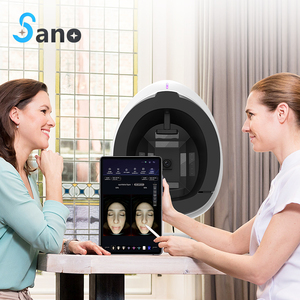
2026 Skin Analysis Machine UV Pore Detector Skin Scanner Analysis Ai Skin Analyzer Beauty Machine For Salon
Contact UsState of Automated Skin Lesion Assessment Technology in China
An in-depth technical analysis on multispectral imaging architectures, AI-driven dermatological diagnostic pipelines, and global procurement strategies.
Clinical Value Proposition: Modern automated skin lesion assessment tools replace subjective visual inspection with quantitative multispectral optics. By mapping epidermal and dermal chromophore distributions—such as melanin, hemoglobin, and porphyrin concentrations—these tools deliver objective micro-structural analytics with sensitivity and specificity benchmarked against histological standards.
Multispectral Optical Physics
Integrates parallel-polarized, cross-polarized, UV fluorescence (365nm Wood's light illumination), and RGB standard light modalities. This multi-spectrum architecture allows non-invasive optical biopsy of skin lesions up to 2.5mm into the dermis.
AI Convolutional Neural Engines
Trained on multi-ethnic clinical datasets encompassing over 5,000,000 validated dermatological cases. The algorithmic models automatically segment lesion boundaries, analyze pigment networks, and calculate asymmetry scores (ABCDE rule automation).
ISO 13485 & Regulatory Standard
Manufactured under strict ISO 13485 quality management frameworks. Systems comply with international electro-magnetic safety (IEC 60601-1) and software life cycle processes (IEC 62304), ensuring seamless registration across global jurisdictions.
Comparative Technical Matrix: Manual Dermoscopy vs. Automated 3D AI Lesion Assessment
| Assessment Parameter | Conventional Handheld Dermoscopy | Advanced Automated 3D AI Assessment Tool | Clinical & Commercial Impact |
|---|---|---|---|
| Optical Illumination Spectrum | Single White Light / Standard Polarized Filter | 6-Spectrum (RGB, Parallel/Cross-Polarized, UV 365nm, Wood's Light, Red/Blue Light) | Sub-surface vascular and deep-pigment visualization without refractive index fluids. |
| Diagnostic Objectivity | Subjective visual interpretation (Operator Dependent) | Automated AI Algorithm (Quantitative Asymmetry, Boundary, Color & Structural Metric) | Eliminates intra-observer variance; provides standard numerical differential scoring. |
| Depth & Volumetric 3D Surface Mapping | 2D Planar Surface Capture Only | 3D Photogrammetric Topography & Sub-surface Volumetric Profiling | Measures lesion thickness, pore depth, elevation changes, and volume displacement over time. |
| Documentation & Cloud Tracking | Manual Image Storage / Disconnected Files | Automated AI Facial/Lesion Match, EHR Integration & Cloud Multi-site Synchronization | Seamless longitudinal monitoring of dysplastic nevi and treatment efficacy tracking. |
| Diagnostic Speed & Report Generation | 15-30 Minutes Manual Charting | Instant Automated Scan (Under 15 Seconds) with 19 Diagnostic Metrics Generated | Increases clinic throughput by 300% while providing patients with transparent visual reports. |
Why Leading Global Brands Partner with Chinese OEM/ODM Manufacturers
Capitalizing on decades of optical engineering expertise, state-of-the-art manufacturing infrastructure, and rigorous quality assurance standards.
Proprietary Optical Hardware
Our in-house optical engineering division develops ultra-high-definition multi-camera arrays, anti-glare polarized filter matrices, and precision-calibrated LED spectrum illuminators ensuring zero distortion across all Fitzpatrick skin types.
Integrated Cloud & AI Ecosystem
Simultaneous development of hardware and cloud management software (such as LifeViz Neo Cloud architectures) allows automated data synchronization, multi-site practice management, and GDPR-compliant secure patient record storage.
Full Regulatory Support
We assist global B2B buyers with comprehensive technical files, clinical evaluation reports (CER), safety certifications, and local registration support to ensure seamless clearance across North America, Europe, Asia-Pacific, and Latin America.
Future Procurement Trends & Technological Innovations
Key growth drivers and technology roadmaps shaping the next generation of skin lesion assessment systems.
1. Hyper-Spectral & Volumetric Imaging Integration
Future diagnostic systems are transitioning from 6-spectrum illumination to hyperspectral sensors capable of capturing narrow-band light reflection across dozens of wavelengths. This enables non-invasive detection of deep dermal lesions, sub-clinical melasma, and early-stage basal cell carcinoma with unprecedented depth-resolving power.
2. Federated Learning & Privacy-Preserving AI
To comply with global data privacy frameworks (such as HIPAA and GDPR), next-generation automated skin analyzers utilize federated AI learning models. Diagnostic algorithms are continuously trained and refined across decentralized hospital networks without raw patient image data ever leaving local premises.
3. Miniaturization & Portable Dermatoscope Ecosystems
While full-face 3D desktop units dominate clinical consultation suites, demand is skyrocketing for ultra-portable, rechargeable, handheld dermatoscope probes (such as Wood's Lamp microscope hybrid systems). These portable tools seamlessly link to tablet interfaces for point-of-care screening and mobile clinical visits.
Frequently Asked Questions for B2B Equipment Buyers
Addressing technical, operational, and commercial queries for medical distributors, aesthetic chains, and hospital procurement officers.
What makes automated skin lesion assessment tools superior to conventional dermatoscopes?
Automated tools combine multispectral illumination with artificial intelligence algorithms to provide standardized, quantitative measurements of skin parameters—such as pigment distribution, vascularity, pore depth, and boundary irregularity. This eliminates the subjective bias inherent in visual examination, speeds up patient consultation times, and generates objective visual records for treatment validation.
How do you ensure AI algorithm diagnostic accuracy across diverse skin tones (Fitzpatrick Types I-VI)?
Our diagnostic AI models are trained on multi-center clinical image datasets collected globally, covering all Fitzpatrick skin types. Furthermore, our optical hardware utilizes cross-polarized filters and calibrated intensity light engines to eliminate epidermal light reflection, ensuring equal color fidelity and depth resolution across varying melanin densities.
Can these automated skin assessment devices integrate with clinic EMR/HIS systems?
Yes. Our advanced 3D skin analyzers and diagnostic software support standard DICOM protocols, RESTful APIs, and cloud-based SDKs (such as LifeViz Neo Cloud compatible frameworks). This allows seamless data exchange with Electronic Medical Record (EMR) systems, automatic patient charting, and multi-branch clinic synchronization.
What OEM/ODM customization services are available for international brand partners?
We offer comprehensive OEM/ODM solutions, including custom industrial design (casing color, dimensions, materials), proprietary UI/UX software branding, custom diagnostic report layout integration, multispectral optical configuration tuning, and private-label packaging.
What are the optical calibration and maintenance requirements for these clinical systems?
Each machine features automated self-calibration protocols upon startup. We provide precision optical calibration boards with certified reflectance targets. Software automatically compensates for ambient light variations, ensuring consistent long-term quantitative image accuracy without requiring frequent factory servicing.
What international quality certifications do your manufacturing facilities hold?
Our manufacturing facilities operate strictly under ISO 13485 certified quality management systems. Our products hold CE medical device markings, RoHS environmental safety compliance, FCC electromagnetic certification, and comply with FDA performance standards for light-emitting medical equipment.