
Aesthetic Medicine & 3D Imaging Blog
Latest clinical research, technical advances, and practice growth insights from LifeViz®.
Flagship 3D Facial Scanners & Aesthetic Diagnostic Systems
Engineered in our state-of-the-art optical manufacturing facility, our medical-grade 3D imaging systems empower rhinoplasty surgeons and dermatologists to capture micro-surface topographies and execute volumetric simulation with mathematical precision.

3D AI Smart Full Face Skin Analyzer HD Touch Screen Facial Scanner
- Sub-millimeter 3D mesh reconstruction engine
- Multi-spectral optical sensors (RGB, UV, PL)
- Automated rhinoplasty dorsal hump calculation
- Integrated HD capacitive touch console

Skin Analysis Device Facial Scanner Diagnosis 3D System
- Quantitative volumetric difference mapping
- Nasal tip projection & columellar angle analyzer
- Deep pore & moisture spectrum diagnostic
- DICOM 3.0 medical cloud sync enabled

Medical-Grade AI Diagnostic System (Puremi 4th Gen 6 Spectrums)
- Dual shooting modes: Frontal & 45/90° lateral
- 6 Clinical light spectrums for sub-surface mapping
- 19 Comprehensive aesthetic baseline reports
- Cartilage shift & volume deficit visualization

Portable 3D Digital Facial Analysis & Surgical Monitor Analyzer
- Compact lightweight chassis for multi-room deployment
- Instant 360-degree facial topography rendering
- AI-assisted patient consultation interface
- Real-time pre/post operation morph comparison

Medical Grade Handheld Dermatoscope & Woods Lamp Inspector
- Rechargeable lithium-ion high-intensity LED array
- Microstructural skin depth visualization (up to 50x)
- Vascular pattern & pigment margin clarity
- Essential accessory for pre-op surgical planning

Clinical 3D Facial Scanner & Aesthetic Simulation Machine
- High-speed stereoscopic capture (<0.5 seconds)
- Automated landmark tracking (128 facial nodes)
- Pre-set rhinoplasty templates (Asian & Western profiles)
- Seamless iPad/PC cloud data interface

Precision Medical-Grade 3D Skin Analyzer & Diagnostic Station
- Cross-polarized optical alignment eliminating skin shine
- Sub-surface dermal layer density evaluation
- Surgical margin & asymmetry heatmapping
- Full OEM/ODM software branding supported
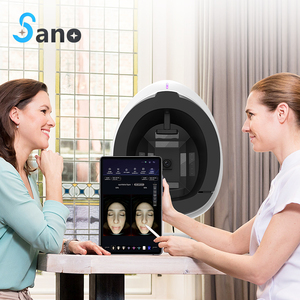
2026 Next-Gen AI Rhinoplasty & Surface Reconstruction Scanner
- Next-generation AI deep-learning skin analysis engine
- Ultra-high UV pore & sebum sensor array
- Biomechanical skin elasticity simulation mode
- Interactive 3D volumetric consultation suite
Why Global Medical Aesthetic Brands Choose Our Manufacturing Infrastructure
As China’s premier high-precision optical device manufacturer, our facility spans over 15,000 square meters of ISO13485-certified cleanrooms and optical assembly suites. We specialize in end-to-end OEM/ODM solutions for plastic surgery groups, aesthetic device distributors, and software platforms worldwide. By synthesizing sub-millimeter stereoscopic imaging hardware with proprietary AI deep-learning algorithms, our solutions bridge the gap between surgical expectation and clinical reality.
Proprietary Optical Hardware Architecture
Custom multi-camera optical setups engineered with zero-distortion industrial lenses. Captures 3D facial geometry in under 0.5 seconds, eliminating artifacts caused by involuntary patient movement or micro-tremors.
AI Volumetric Morphing & Cartilage Engines
Our algorithms do not merely deform pixels; they simulate underlying anatomical constraints. Calculate tissue elasticity, nasal tip rotation, dorsal hump excision, and autologous cartilage graft volumes precisely.
Rigorous ISO13485 & CE Quality Control
Every unit undergoes 72-hour continuous thermal stress testing, spectral calibration using NIST-traceable standards, and electromagnetic compatibility checks to guarantee years of reliable clinical operation.
How 3D Facial Topography Transforms Rhinoplasty Consultation Workflows
Traditional 2D medical photography suffers from severe inherent limitations: lens focal length distortion, inconsistent flash lighting, angle variance, and the complete absence of depth metrics. In complex aesthetic and reconstructive procedures like rhinoplasty, relying on 2D images creates significant gaps between patient expectations and achievable surgical outcomes.
Our 3D simulation systems utilize structured light projector technology combined with multi-angle stereoscopic vision. By projecting non-harmful phase-shifted fringe patterns onto the human face, the software records over 1.2 million point-cloud vector coordinates. This allows surgeons to measure parameters such as the Goode Ratio (nasal projection to length), Columellar-Labial Angle (typically 95°-105° for females, 90°-95° for males), and Rhinion Hump Elevation with sub-millimeter resolution.
Standard 2D Photography vs. Advanced 3D Simulation Systems
| Evaluation Parameter | Traditional 2D Medical Photography | China Top Factory 3D Simulation System |
|---|---|---|
| Volumetric Accuracy | None (Qualitative flat visual estimation) | Sub-millimeter volumetric differential measurement (in cc or mm³) |
| Standardization | Highly variable due to camera positioning & room lighting | Automated fixed-distance alignment & multi-spectral LED calibration |
| Surgical Pre-Visualization | Static 2D Photoshop warping (Unrealistic elasticity) | 3D Dynamic Mesh Simulation conforming to anatomical cartilage constraints |
| Patient Trust & Conversion | Moderate; patient struggles to visualize 3D facial harmony | High; interactive 360° rotational simulation increases surgical sign-offs by >35% |
| Post-Op Analysis | Subjective visual comparison | 3D Heatmap superimposition showing exact tissue swelling vs. removed volume |
Future Procurement Trends: Where Plastic Surgery 3D Imaging is Headed
As healthcare equipment buyers, medical aesthetic clinic chains, and international distributors evaluate capital expenditure for 2026 and beyond, several macro-technological trends are reshaping procurement priorities in the aesthetic 3D imaging sector:
1. AI-Driven Predictive Biomechanics
Procurement is shifting from passive 3D viewers to active AI engines that predict post-operative skin contraction, scar tissue contraction, and long-term cartilage settling. Systems integrated with generative AI biomechanical models are taking market priority.
2. Cloud-Native Ecosystems & Multi-Hospital Centralization
Enterprise clinic chains require centralized database solutions (such as Neo Cloud architectures) allowing a patient scanned at a branch clinic to be instantly analyzed by a senior surgeon operating in a regional surgical hub.
3. Hybrid 3D Facial & Micro-Surface Skin Diagnostics
Buyers no longer want separate skin analyzers and surgical simulators. The market demands single-session multi-spectral scanning that simultaneously analyzes dermal health (pigment, pore structure, vascularity) and 3D structural contouring.
4. AR & VR Patient Immersion Suites
Forward-thinking plastic surgery centers are adopting system hardware capable of exporting 3D facial models directly into Virtual Reality headsets or 3D 4K monitors, allowing patients to view their prospective new nose profile in a lifelike, immersive setting.
Technological Development Trends in China's Optical R&D Sector
As a leading original manufacturer in China's high-tech manufacturing corridor, our R&D team continuously pushes the boundaries of optical physics and software engineering. Here is an inside look at the technical benchmarks shaping next-generation rhinoplasty simulation systems:
Sub-Surface Light Scattering (SSLS)
Realistic rendering of human nasal cartilage and skin skin texture requires accounting for translucent photon scattering. Our proprietary rendering pipeline simulates skin translucency in real time, avoiding the unnatural "plastic mask" look common in legacy software.
Automated Facial Feature Vectorization
Utilizing deep convolutional neural networks trained on over 500,000 anonymized clinical facial datasets, our software automatically identifies key anatomical landmarks (nasion, pronasale, subnasale, alar crease) without manual pin placement.
Modular Optical Sensors
To provide distributor clients with maximum flexibility, our hardware features modular camera and lighting assemblies that can be field-upgraded from standard RGB to 6-spectral multi-polarization arrays without replacing the entire console.
Frequently Asked Questions (FAQ) for Global Buyers
Everything you need to know about factory direct sourcing, OEM customization, technical integration, and shipping compliance.
Ready to Upgrade Your Clinic or Distribution Portfolio?
Contact our senior engineering and business development team today to request a factory-direct price catalog, schedule a live remote software demonstration, or discuss OEM partnership terms.