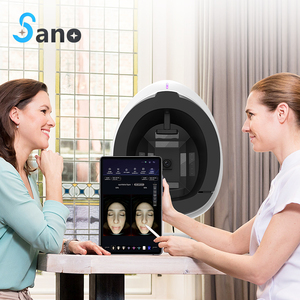
Clinical Equipment Selection
Featured Medical-Grade UV Fluorescence & 3D Skin Analyzers
Explore our flagship OEM/ODM clinical diagnostic systems engineered for plastic surgery centers, medical spas, and dermatological research institutions. Equipped with multispectral light engines, deep UV-A excitation, and cloud-integrated diagnostic engines.
3D AI Smart Full Face Skin Analyzer HD Imaging Touch Screen Facial Scanner
Core Tech: 3D AI Facial Scanning, Deep UV Fluorescence, Multi-Pore Diagnostic
Get a Quote
Skin Analysis Device Facial Scanner Diagnosis 3D System Testing Moisture Evaluation
Core Tech: Hydration Impedance, Pigmentation Depth Matrix, Vascular Mapping
Get a Quote
Medical-Grade AI Skin Diagnostic Device Puremi 4th Gen 6 Spectrums 19 Reports
Core Tech: 6 Optical Spectrums, 19 Detailed Derm Diagnostic Reports, Front/Side Capture
Get a Quote
High Quality Portable Facial Analysis Skin Monitor Analyzer 3D Digital Machine
Core Tech: Compact Mobile Enclosure, High-Res RGB/UV Sensors, Fast Consult Engine
Get a Quote
Portable Woods Lamp Medical Grade Microscope Dermatoscope Skin Hair Analyzer
Core Tech: 365nm UV Wood's Optical Filter, Magnified Dermal Microscope, Follicle Scanner
Get a Quote
New Arrival 3D Skin Analyzer Facial Machine Skin Analysis Scanner System
Core Tech: Automated Ergonomic Positioning, 3D Mesh Volumetric Comparison
Get a Quote
Medical Grade Skin Analyzer Device With Precision Imaging for Dermal Diagnosis
Core Tech: Clinical Grade Sensor Grid, Sub-surface Erythema Detection, Cloud EMR Sync
Get a Quote
2026 Skin Analysis Machine UV Pore Detector Skin Scanner AI Beauty Analyzer
Core Tech: Next-Gen AI Telemetry, Hyper-Pores UV Fluorescence, Aesthetic Trend Engine
Get a Quote
Enterprise Authority & Innovation
Engineering Excellence in Medical 3D & UV Dermal Telemetry
With a quarter-century of pioneering optical research, our manufacturing framework stands at the intersection of quantitative dermatology, optical physics, and clinical Artificial Intelligence. We provide global medical chains, plastic surgeons, and research dermatologists with reproducible, clinically validated skin analysis hardware and cloud platforms.
14
Global Patents Registered
7
International Industry Awards
"Quantitative clinical diagnostics require optical standardization. Our optical systems maintain sub-millimeter geometric fidelity and calibrated 365nm UV peak emission to ensure long-term clinical trial repeatability."
Optical Physics & Biophysics
The Science of Clinical UV Fluorescence & Multispectral Surface Analysis
Clinical ultraviolet (UV) fluorescence imaging operates on the biophysical principle of specific fluorophore excitation within the dermal and epidermal strata. When irradiated by narrow-band ultraviolet light (typically centered at 365 nm, matching classic Wood’s light excitation spectrum), endogenous biomolecules and bacterial metabolites absorb high-energy photons and emit secondary fluorescence at longer, visible wavelengths.
Porphyrin Fluorescence
Cutibacterium acnes synthesizes metabolic Coproporphyrin III and Protoporphyrin IX. Under 365nm UV-A excitation, these fluorophores fluoresce bright orange-red, exposing active follicular colonization prior to visible acne lesions.
Dermal Pigmentation Mapping
Epidermal melanin absorbs UV light strongly, creating sharp high-contrast hyperpigmented boundaries. Sub-dermal melasma and deep sun damage invisible under normal RGB light become clearly quantifiable.
Cross-Polarized Erythema
By eliminating superficial specular reflection through cross-polarization filters, optical sensors isolate hemoglobin absorption to quantify telangiectasia, rosacea, and post-inflammatory erythema (PIE).
Modern clinical systems merge UV fluorescence with parallel cross-polarized RGB photography, standard illumination, and 3D surface stereophotogrammetry. This multispectral synergy allows aesthetic physicians to evaluate both structural skin volume (e.g., midface sagging, nasolabial folds) and histological tissue health (e.g., lipid distribution, pore occlusion, barrier moisture) in a single capture sequence.
Strategic Industry Outlook
Future Procurement Trends for Clinical Skin Analyzers (2026–2030)
As global demand for non-invasive aesthetic procedures and targeted dermatological therapies accelerates, the procurement parameters for clinical skin analyzer equipment are undergoing a structural shift. Procurement directors across hospital chains, cosmetic dermatology networks, and OEM/ODM distributors must align purchasing decisions with four macro trends:
1. AI Deep Learning Telemetry
Transitioning from simple color-threshold image software to deep convolutional neural networks (CNNs) trained on millions of dermatological images. Systems now deliver automated clinical grading ( Fitzpatrick skin type alignment, Glogau photo-aging scores, and quantitative wrinkle severity index).
2. Cloud Synchronization & Multi-Site EMR Integration
Leading aesthetic chains demand centralized cloud management platforms like LifeViz® Neo Cloud. Patient 3D models and UV diagnostic profiles must synchronize seamlessly across clinic networks, enabling multi-site longitudinal tracking and HIPAA/GDPR-compliant data security.
3. Quantitative Volumetric & Treatment Validation
Clinics require objective metrics to validate hyaluronic acid (HA) filler retention, biostimulator collagen synthesis, laser resurfacing efficacy, and surgical body contouring. Micro-volumetric displacement mapping (measured in cc or mm³) has become a standard requirement for patient retention.
Procurement Insight for Chain Medical Spas: Purchasing decisions are shifting from hardware standalone costs to long-term Software-as-a-Service (SaaS) scalability, optical sensor stability, and automated patient consultation conversion tools.
B2B Purchasing Evaluation
Global Manufacturer Selection Framework & Technical Comparison
To assist medical equipment buyers, clinic owners, and international distributors, our engineering team has synthesized a performance benchmark matrix evaluating the key engineering parameters across top-tier clinical skin analyzer manufacturers worldwide.
| Evaluation Parameter |
Tier-1 Medical Grade Manufacturers |
Standard Commercial Grade Suppliers |
Basic Salon Grade Units |
| Optical Spectrum Coverage |
6–8 Spectrums (UV 365nm, Cross-Polarized, Parallel, RGB, Wood's, Red Light) |
3–4 Spectrums (Standard RGB, Basic UV) |
1–2 Spectrums (Uncalibrated White/Blue LED) |
| Optical Sensor & Lens |
24MP+ DSLR / Industrial CMOS; Optical Distortion <0.02% |
12MP–16MP Consumer CMOS Sensors |
2MP–5MP USB Webcam Grade Modules |
| 3D Stereophotogrammetry |
Sub-millimeter mesh registration (0.1mm accuracy), Volumetric displacement calculation |
Qualitative 2.5D visual depth approximation |
None (Flat 2D photography only) |
| Regulatory & Quality Compliance |
FDA 510(k) Cleared, CE Medical Class IIa, ISO 13485 Certified |
Standard CE (LVD/EMC), RoHS |
Basic CE Mark only |
| Software Architecture |
AI Neural Network Telemetry, Multi-Site Cloud Sync (HIPAA/GDPR compliant) |
Local Windows Software, Manual File Exports |
Standalone Mobile App (Tablet bound) |
| Long-term Calibration |
Factory Laser-Calibrated Light Engine, Integrated Photometer Recalibration |
Manual Software White Balance adjustment |
No optical calibration support |
Procurement FAQs
Frequently Asked Questions by Clinical Equipment Buyers
How does 365nm UV fluorescence differentiate deep dermal pigmentation from superficial epidermal freckles?
Ultraviolet light at 365nm is strongly absorbed by epidermal melanin. Superficial (epidermal) pigment absorbs UV light intensely, appearing sharply defined and significantly darker under UV fluorescence mode. In contrast, deep dermal melanin (found in deep dermal melasma or nevus of Ota) is located beneath the dermo-epidermal junction; because UV light undergoes scattering in the upper dermis, dermal pigment exhibits less dramatic contrast under UV light compared to standard polarized light. By mathematically comparing cross-polarized white light images with 365nm UV fluorescence captures, clinical AI algorithms accurately segregate pigment depth into epidermal, dermal, or mixed categories.
What regulatory medical certifications are mandatory when importing clinical skin analyzers into North America and the EU?
For medical diagnostic classification in North America, devices providing clinical diagnostic reports or treatment simulations require FDA 510(k) clearance or FDA registration depending on intended use claims. In the European Union, under the Medical Device Regulation (MDR 2017/745), diagnostic skin analyzers utilized for clinical decision-making must hold CE Medical Class IIa certification. Furthermore, manufacturing facilities must operate under ISO 13485 certified Quality Management Systems. Equipment destined for cosmetic or non-medical spa use may enter under CE EMC/LVD directive compliance, but cannot carry medical diagnostic claims.
Why is controlled optical calibration essential for multi-center clinical trials and franchise clinic networks?
Without strict optical calibration, ambient light fluctuations, spectral LED decay over time, and focal distance variance induce significant error in longitudinal image comparison. Medical-grade manufacturers implement standardized darkroom hoods, fixed focal distance chinrest positioning, constant-current LED drivers, and automated photometer white-balance protocols. This guarantees that image color values (LAB color space) and volumetric measurements remain reproducible across multiple geographic clinic sites and over multi-month clinical trial timelines.
How do 3D AI skin analyzers increase patient consultation conversion rates and treatment compliance?
Visual quantification transforms subjective patient consultation into objective scientific evaluation. When patients see 3D volumetric heat maps of midface volume loss or hidden UV porphyrin fluorescence indicating sub-surface acne risk, their understanding of underlying dermal pathology increases dramatically. Clinical studies demonstrate that medical practices utilizing standardized 3D/UV visualization achieve a 35% to 50% increase in patient conversion for multi-session treatment plans (such as biostimulatory injectables, laser series, and medical skincare regimens) because treatment efficacy can be objectively proven at follow-up visits.
What OEM/ODM customization options are available for global distributors and pharmaceutical brand partners?
Top-tier original equipment manufacturers offer comprehensive OEM/ODM solutions. Hardware customization includes industrial chassis color design, custom LED spectrum selection, branding laser engraving, and custom optical hood dimensions. Software customization encompasses white-label UI rebranding, specialized AI skincare algorithm integration, custom cosmetic product database matching, API/SDK integration with practice management EMR systems, and localized multilingual user interfaces.
What is the typical operational lifespan and maintenance requirement for medical-grade UV skin scanners?
A premium medical-grade skin analyzer engineered with solid-state LED illumination and high-grade optical sensors has an operational lifespan exceeding 50,000 active scanning cycles (typically 7–10 years of intensive clinic operation). Maintenance involves routine optical window cleaning with non-abrasive microfiber, annual software algorithm updates, and periodic photometer re-calibration checks. Remote telemetry integrated into modern cloud platforms allows engineers to perform diagnostic checks on LED output stability over the air.
Accelerate Your Practice with Advanced 3D & UV Dermal Telemetry
Whether you are seeking OEM/ODM manufacturing partnerships, equipping a multi-site aesthetic chain, or seeking state-of-the-art diagnostic solutions for your clinic, our team of optical engineers and product specialists is ready to assist.
Get a Quote