
Aesthetic Medicine & 3D Imaging Blog
Latest clinical research, technical advances, and practice growth insights from LifeViz®.
Advanced 3D & Spectral Facial Imaging Solutions
Engineered for precision rhinoplasty modeling, volumetric skin analysis, and seamless patient consultation in competitive Japanese clinical environments.

3D AI Smart Full Face Skin Analyzer HD Imaging Touch Screen Facial Scanner
Integrated touchscreen platform featuring high-definition optical sensors and AI automated acne, pigmentation, wrinkle, and pore density indexing tailored for Asian skin types.
Contact Us
Skin Analysis Device Facial Scanner Diagnosis 3D System Testing
Multispectral facial diagnostic system delivering digital inspection of moisture, sebum, pigmentation, and deep dermal aging matrices for pre-surgical planning.
Contact Us
Medical-Grade AI Skin Diagnostic Device Puremi 4th Gen (6 Spectrums)
Fourth-generation clinical diagnostic powerhouse utilizing 6 optical spectrums, dual front/side shooting modes, and 19 standardized analytical diagnostic reports.
Contact Us
High Quality Portable Facial Analysis Skin Monitor Analyzer 3D Digital
Compact, ultra-portable 3D digital scanner tailored for cosmetic surgery consultation rooms, satellite medical suites, and high-end Japanese aesthetic salons.
Contact Us
Portable Wood's Lamp Medical-Grade Microscope Dermatoscope
Handheld rechargeable clinical microscope for high-magnification dermal inspection, follicular evaluation, and localized micro-structure post-rhinoplasty assessment.
Contact Us
New Arrival 3D Skin Analyzer Facial Machine Scanner
State-of-the-art 3D surface scanning station optimized for rapid anatomical mesh creation, nasal bridge volume calculations, and real-time morphing simulations.
Contact Us
Medical Grade Skin Analyzer Device with Advanced Diagnostic Imaging
Precision clinical imaging console designed for dermatological and surgical practice, offering reproducible lighting conditions and differential volume map comparisons.
Contact Us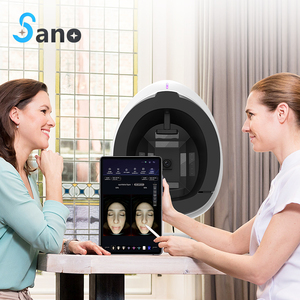
2026 Flagship AI Skin & Facial Simulation Machine with UV Detector
Next-generation smart imaging tower featuring AI-driven multi-dimensional surface mapping, ultra-precise UV vascular detection, and seamless cloud integration.
Contact UsRhinoplasty 3D Simulation Hardware & Algorithmic Standards in Japan
The Japanese cosmetic surgery ecosystem—centered around elite clinical districts in Ginza, Omotesando, Roppongi, and Umeda—demands an unprecedented tier of objective precision during rhinoplasty consultations. Unlike Western anatomical trends focused predominantly on dorsal reduction or humpectomy, East Asian rhinoplasty procedures in Japan prioritize delicate, multi-dimensional restructuring. Common surgical objectives include nasal tip projection, radix elevation, alar base narrowing, columellar lengthening, and delicate cartilage autograft positioning (using ear costal or septal cartilage).
In this clinical context, traditional 2D imagery and subjective hand drawings fail to communicate sub-millimeter surgical plans effectively. This gap often leads to post-operative psychological misalignment between surgeon and patient. As a premier original equipment manufacturer (OEM) and direct factory source, our medical-grade 3D simulation systems combine stereo-photogrammetry optics with localized Asian morphometric neural networks. This guarantees sub-millimeter topographical reconstruction, empowering Japanese clinic directors to visualize micro-volumetric changes before the first incision is made.
Technical Specification Matrix: Medical 3D Simulation vs. Legacy 2D Systems
| Diagnostic Parameter | Legacy 2D Digital Imaging | Generic Consumer 3D Scanners | Factory Medical-Grade 3D Simulation |
|---|---|---|---|
| Optical Methodology | Single-plane RGB Sensor | Structured Infrared Light | Dual-Camera Stereo-Photogrammetry + UV |
| Volumetric Accuracy | Non-calculable (2D pixel estimate) | ± 1.5 mm to 2.5 mm | Sub-millimeter (< 0.1 mm precision) |
| Nasal Morphometric Indices | Manual grid overlay | Basic distance vectors | Automated Nasolabial & Nasofacial Angles |
| Asian Facial Database AI | Absent | Western-centric training data | Deep-trained on Asian Facial Architectures |
| Clinical Data Privacy | Local desktop unencrypted | Standard cloud storage | ISO/IEC 27001 & PMDA Security Compliant |
Localized Application Scenarios across Japan’s Medical Ecosystem
Our manufactured 3D rhinoplasty diagnostic stations are custom-engineered to integrate seamlessly into diverse operational workflows across Japanese healthcare facilities:
Tokyo Ginza & Omotesando Cosmetic Clinics
In high-density aesthetic districts where patient consultation conversion is vital, our 3D simulation machines serve as central communication hubs. Surgeons can instantly modify the nasal bridge elevation, adjust the cartilage rotation angle, and demonstrate predicted 360-degree postoperative outcomes in high-definition visual renderings during initial consultations.
University Hospitals & Reconstructive Surgery Units
In major medical centers in Osaka, Nagoya, and Fukuoka, academic plastic surgeons utilize our sub-millimeter volumetric differential analysis to evaluate structural trauma, congenital cleft lip and palate nasal deformities, and post-tumor nasal reconstruction, delivering objective measurement for peer-reviewed research.
Multi-Branch National Aesthetic Chains
For large medical groups operating dozens of satellite clinics across Kanagawa, Saitama, and Hokkaido, our cloud-synchronized central architecture enables standardized patient diagnostic tracking, cross-clinic consultations, and centralized data governance fully aligned with Japanese regulatory norms.
Market Dynamics & Regulatory Landscape in Japan
The Japanese aesthetic medical market is governed by rigorous expectations surrounding equipment reliability, low noise output, compact footprints (due to clinic spatial constraints in metropolitan Tokyo), and intuitive software interfaces. In recent years, guidelines highlighted by the Japanese Society of Aesthetic Plastic Surgery (JSAPS) emphasize the necessity of managing patient expectation gaps to prevent post-surgical litigation and dissatisfaction.
Furthermore, Japanese procurement officers prioritize hardware compliance with local electrical safety regulations (PSE Mark certification), seamless operation at 100V (50Hz in Eastern Japan / 60Hz in Western Japan), DICOM compatibility for hospital PACS integration, and robust data encryption compliant with local personal information protection laws (APPI). Our manufacturing facilities specifically build tailored hardware and localized software variants to fulfill every Japanese clinical requirement directly from the production line.
Frequently Asked Questions by Japanese Clinic Buyers
Key technical, regulatory, and supply chain answers for clinic directors, purchasing officers, and distributor partners in Japan:
How accurate is the 3D volumetric simulation for East Asian nasal tip and bridge modifications?
Our systems utilize calibrated dual-camera stereo-photogrammetry coupled with sub-millimeter mesh extraction algorithms. This achieves a volumetric error margin below 0.1 mm, enabling plastic surgeons to model subtle cartilage grafts, radix augmentation, and alar reshaping with absolute geometric precision.
Are your diagnostic devices fully compliant with Japanese electrical and regulatory standards?
Yes. All factory hardware exported to Japan is built to operate natively on 100V AC (50/60Hz) power supplies and carries necessary PSE electrical safety compliance. We also support local distributor partners in fulfilling PMDA medical device registration requirements where applicable.
Does the software interface support native Japanese language and localized reports?
Absolute precision extends to our software UI. We offer fully localized Japanese software operating environments, complete with standardized Japanese analytical PDF reports that can be printed or emailed directly to patients post-consultation.
What factory OEM/ODM customization options are available for Japanese clinic brands?
As a direct manufacturer with over 25 years of imaging expertise, we provide extensive OEM/ODM services including custom chassis industrial design, private-label branding, customized UI themes, unique spectral sensor configurations, and SDK/API integration for clinic management software.
How is optical calibration maintained over long-term intensive daily clinical use?
Our hardware incorporates self-correcting optical targets and automated digital calibration routines. Clinics receive standardized calibration kits and automated firmware diagnostics that verify lens distortion parameters, ensuring optical consistency across thousands of patient scans.
What are the shipping lead times and technical warranty terms for Japanese importers?
Direct factory orders are dispatched via express air freight to Tokyo (NRT/HND) or Osaka (KIX) within 7–14 business days. All systems come backed by a comprehensive multi-year factory warranty, spare parts inventory guarantee, and 24/7 technical assistance.
Why Partner Directly with Our Manufacturing Operations?
By eliminating intermediary trading channels, Japanese clinic chains, surgical equipment distributors, and OEM partners gain direct access to cutting-edge 3D stereophotogrammetry research and factory-direct pricing. With over 25 years of accumulated imaging expertise, 14 international patents, and equipment operational across 50+ countries, our manufacturing base stands as a global beacon of optical innovation.
Whether you require a single flagship 3D simulation tower for a luxury Ginza practice or an OEM fleet of custom diagnostic units across Japan, our engineering teams ensure seamless optical calibration, rigorous quality control, and unparalleled clinical satisfaction.
Schedule a Technical Consultation or Request OEM Specifications
Connect directly with our senior optical engineers and regional Japan market specialists to discuss bulk factory orders, customized software integrations, or clinical demonstration models.
Contact Us